





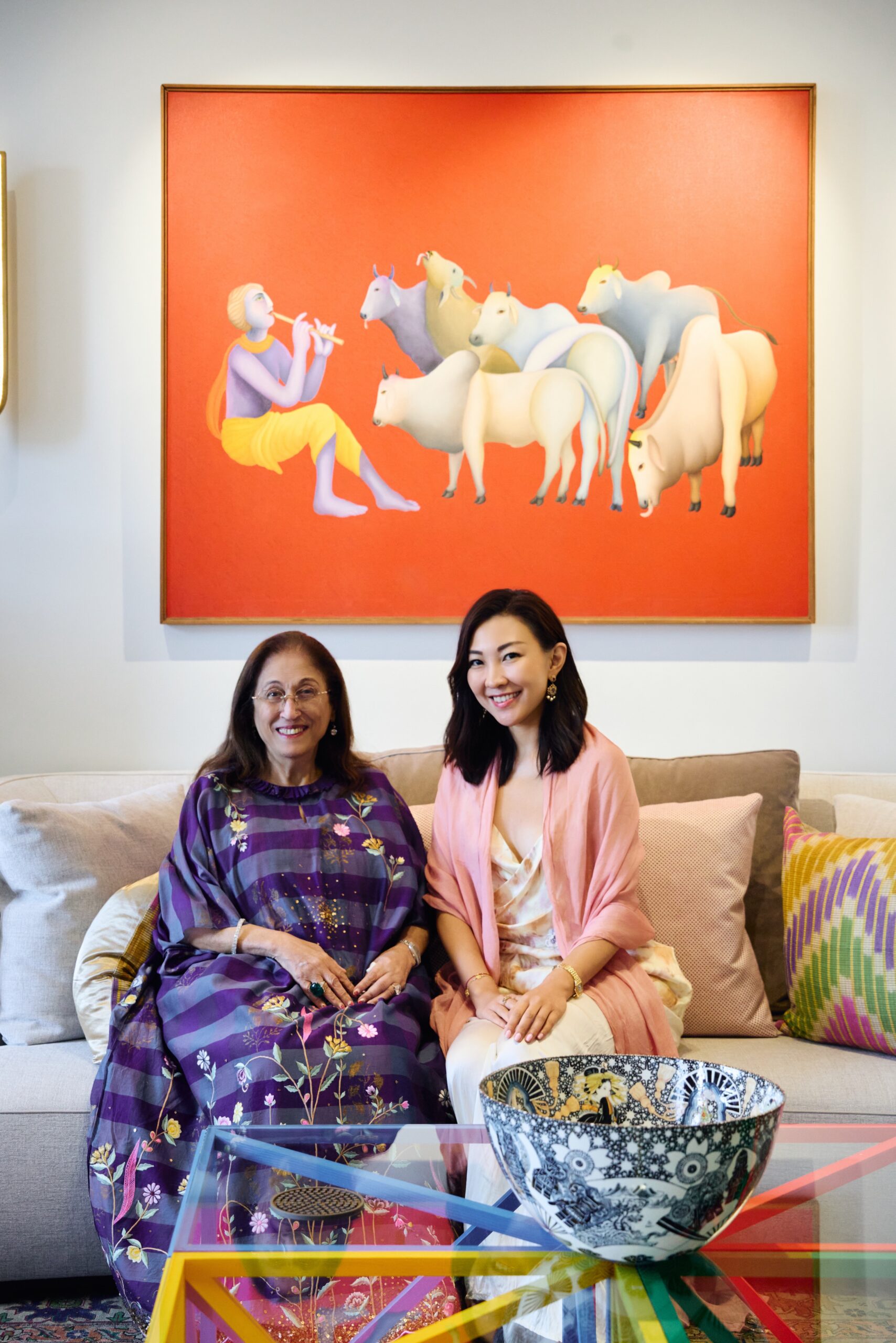
Kiran Nadar and Luning Wang at Kiran’s London home
To say that the wheel has come full circle might be a little unkind to London.
More than two centuries ago, the British arrived in India under the auspices of trade, before establishing colonial rule that would last for nearly two hundred years. Today, the traffic in capital runs rather differently. London has become an important fixture in the global geography of Indian wealth and, in summer especially, a gathering place for the country’s international elite.
Stories about wealthy Indians in the British capital tend, predictably enough, to concern money, property and business. Mayfair has rarely struggled to find uses for a new fortune. But in mid-July this year, an exhibition at Christie’s London turned attention to another form of capital: cultural.
In collaboration with the Delhi-based Kiran Nadar Museum of Art (KNMA), Christie’s presented a curated selection from the museum’s remarkable holdings, bringing together significant figures in South Asian modern and contemporary art.
But this is not simply another story about a billionaire family putting its private collection on display. Over the past decade or so, and noticeably faster in recent years, Indian private wealth has been moving into institution-building. It is helping to develop the country’s cultural life at home, while giving Indian culture a greater presence internationally. India is becoming an increasingly confident presence on the global art map, and KNMA’s founder, Kiran Nadar, is one of the figures who best represents that change.
Nadar’s husband, Shiv Nadar, was one of the first generation of entrepreneurs to build India’s IT industry. HCL, or Hindustan Computers Limited, which he founded in 1976, has grown into HCLTech, one of India’s largest global IT services companies. Shiv Nadar himself has long been a fixture on the world’s rich lists.
Kiran Nadar began collecting art in the 1990s, initially, as many collectors do, to furnish her home. The collection grew; eventually, the available walls did not. To consign the works to storage seemed a rather unsatisfactory conclusion to the exercise, and Nadar began to consider whether they might instead serve a public purpose.
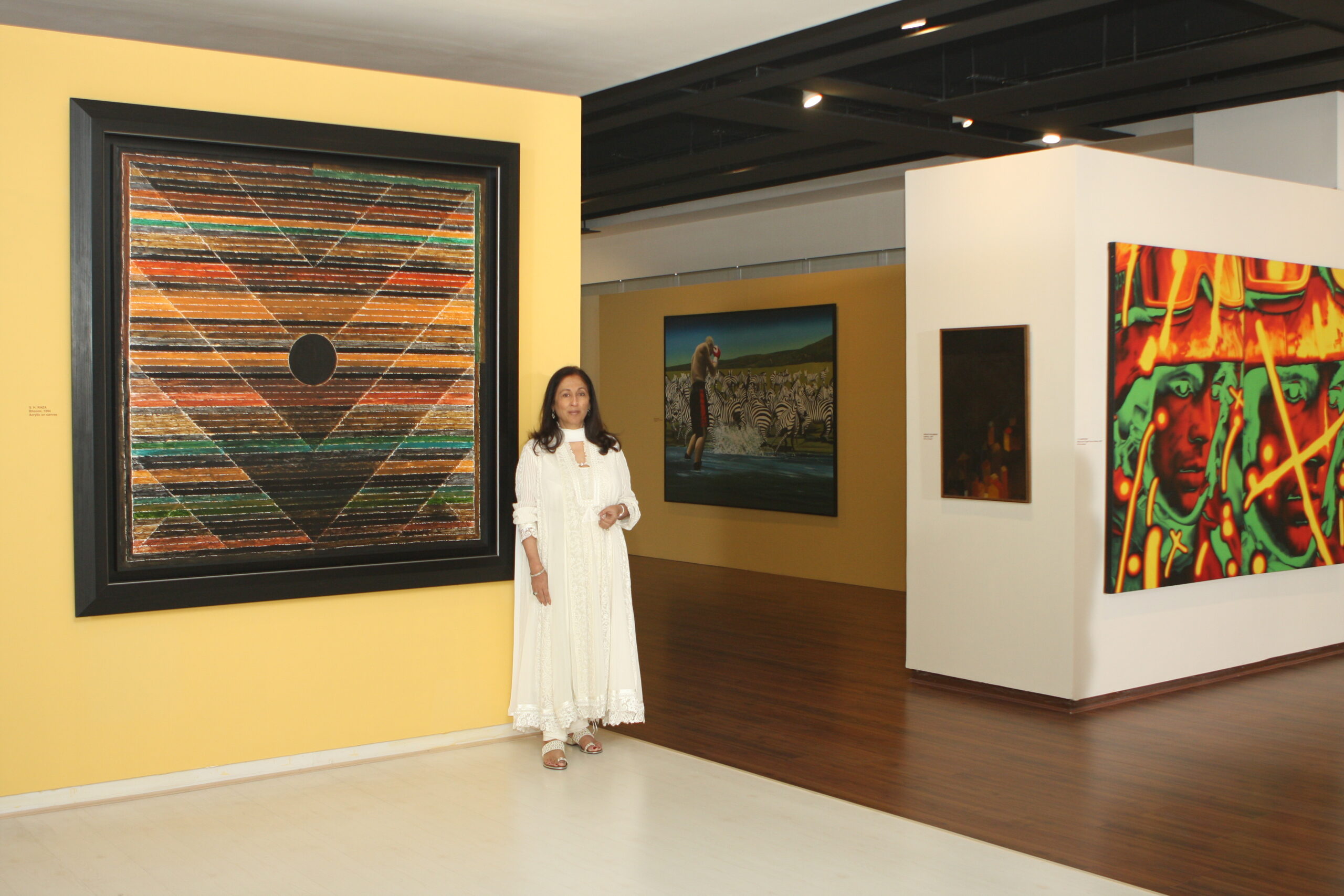
Kiran Nadar, Chairperson, KNMA, at Open Doors, the inaugural exhibition at KNMA, Noida, 1 January–31 October 2010. Curated by Roobina Karode, Director and Chief Curator, KNMA.
In 2010, she opened KNMA’s first space in Noida, outside Delhi, followed by another in a shopping centre in Saket. KNMA became India’s first private museum dedicated to modern and contemporary art, with collecting, research, exhibitions and public education at the heart of its programme.
The collection is predominantly South Asian, but also includes miniature paintings from the 14th to 16th centuries, antiquities and sculpture, as well as works by internationally known artists including Anish Kapoor, Raqib Shaw, Antony Gormley, William Kentridge and Anselm Kiefer.
Earlier this year, KNMA announced the appointment of Manuel Rabaté, formerly director of Louvre Abu Dhabi, as its new CEO. More ambitious still is the institution now taking shape along National Highway 8, on the route to Delhi’s Indira Gandhi International Airport: a new museum expected to open within the next two or three years.
Once completed, it will be the largest museum and cultural centre in South Asia. Visual art will sit alongside music, dance and theatre, with temporary exhibitions, permanent displays and live performances, while works from the collection will be shown in rotation. It marks a considerable expansion of KNMA’s ambitions: not simply an art museum, but a multidisciplinary cultural institution. Running out of wall space, in other words, has led somewhere rather larger than a storage unit.
I met Kiran Nadar at her home in Regent’s Park in London. We talked about how KNMA has evolved since it was founded; the gaps it has tried to fill in Delhi’s cultural life; how it has grown alongside the changes taking place in India; and how the museum sits alongside the family’s longstanding philanthropy in education.
What interested me most, however, was how this private museum, firmly rooted in India, is using its collection, exhibitions and international partnerships to bring greater attention to Indian art around the world.
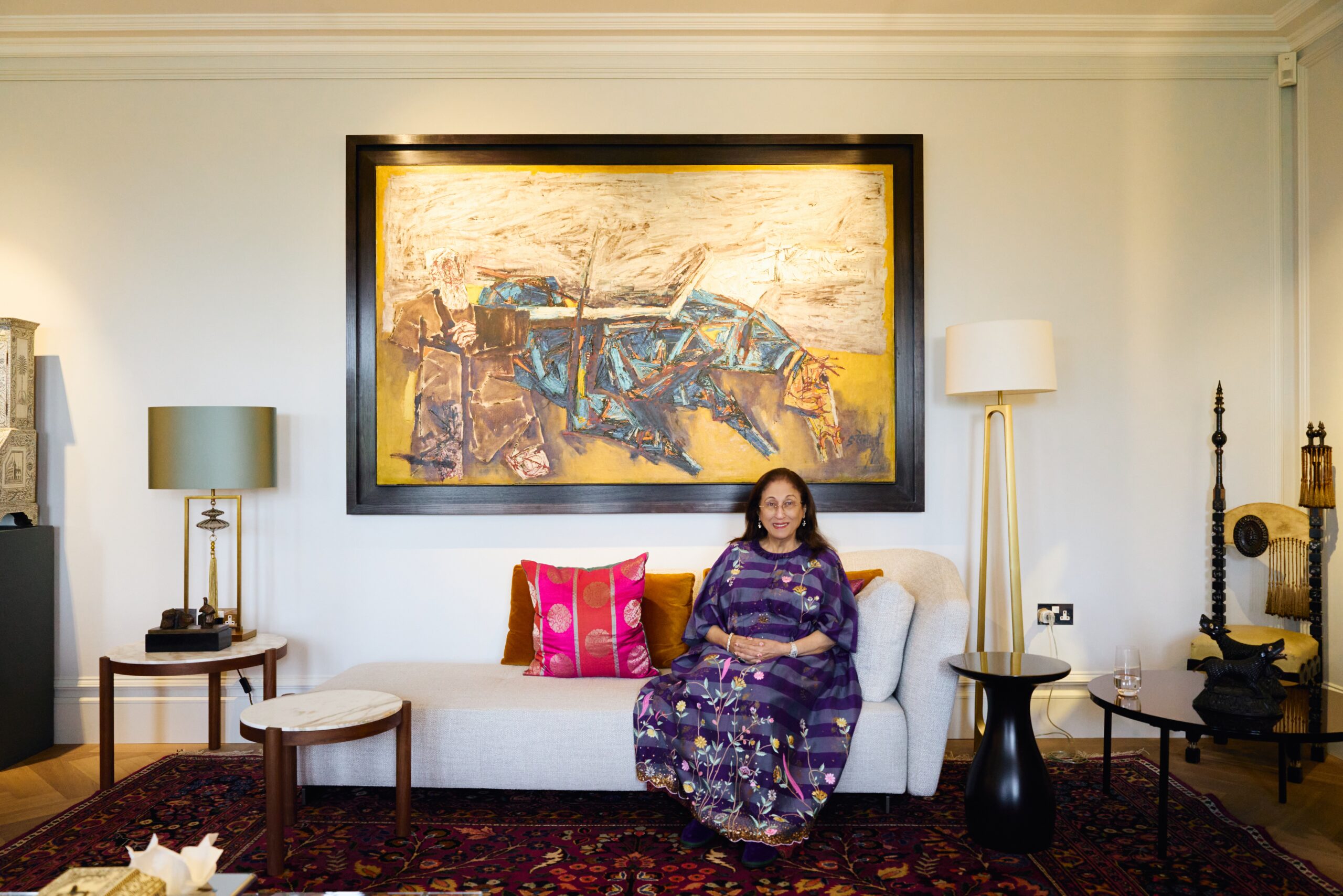
Kiran Nadar in her London home
When KNMA was founded in the early 2010s, Nadar tells me, one major difference between Delhi and cities such as Mumbai and Kolkata was that Delhi did not yet have a large, established museum-going public.
It was not that the city lacked museums. Delhi had both the National Gallery of Modern Art and the National Museum. But public participation remained limited. In Nadar’s view, neither the level of investment nor the way exhibitions were presented had really succeeded in reaching a wider audience.
“If people are not coming to you, you eventually go to them,” she says.
And so that was exactly what KNMA did.
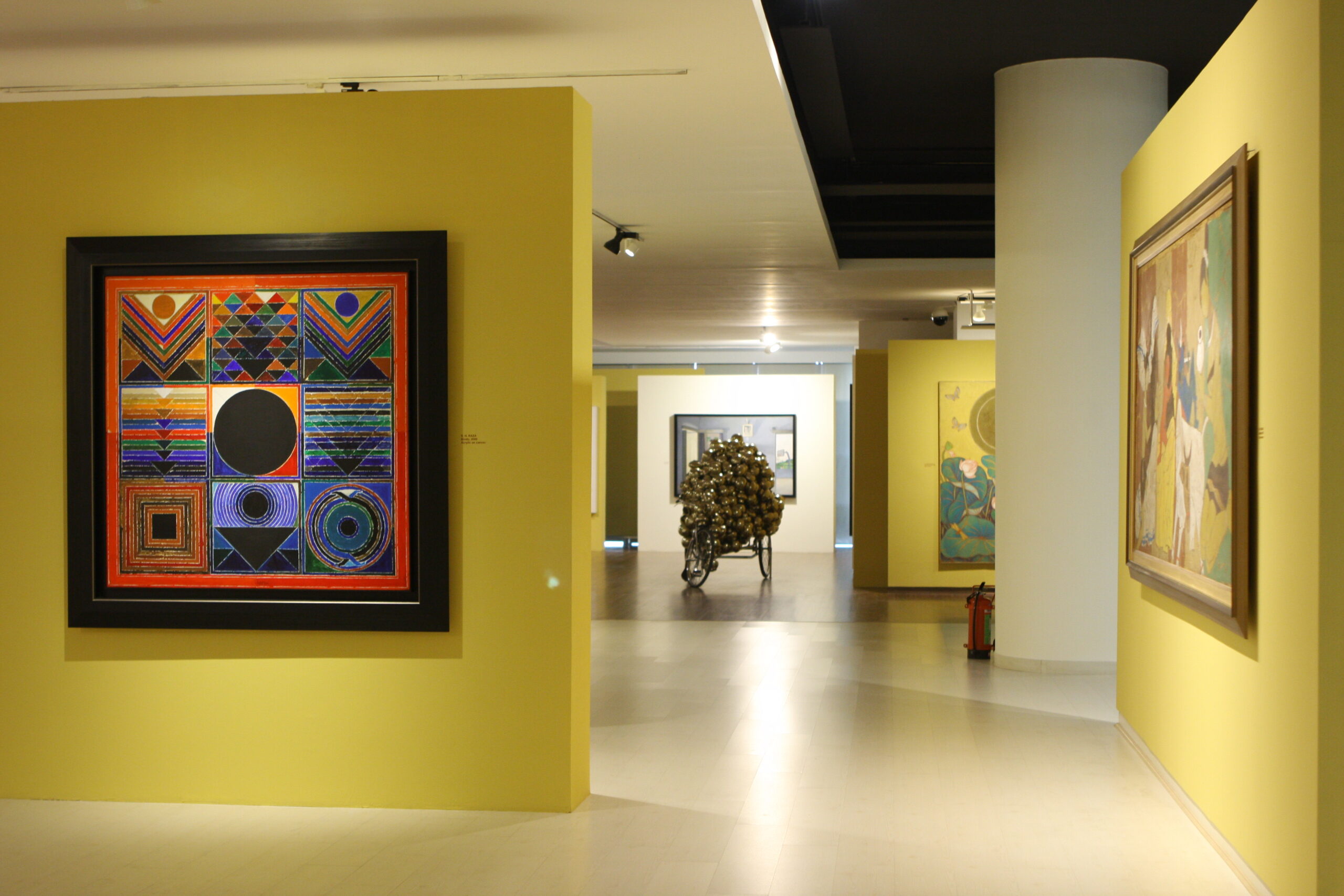
Installation view of Open Doors, the inaugural exhibition at KNMA, Noida, 1 January–31 October 2010. Curated by Roobina Karode, Artistic Director and Chief Curator, KNMA. Image: Courtesy KNMA.
In a city where museum-going was not yet a habit, the museum could not simply wait for an audience to appear. It had to create one. KNMA took exhibitions outside its own galleries and into shopping centres and other spaces that were part of everyday life. If Delhi was not yet going to the museum, the museum would go to Delhi. At the same time, it invested steadily in arts education, cultivating a new generation of museum-goers.
Nadar remembers when the museum received only around 30 student visitors a month. Today, it welcomes an average of four or five schools a day — more than 100 students — and sometimes has to turn schools away for lack of space. For an institution that once had to go looking for its audience, having too much of one is not a bad problem to acquire.
The museum’s emphasis on education follows a much longer tradition of philanthropy in the Nadar family, much of it carried out by building institutions rather than making one-off donations.
KNMA is one of the main cultural institutions of the Shiv Nadar Foundation, established by Kiran’s husband with education as one of its priorities from the beginning.
In 2009, the foundation launched VidyaGyan, which selects students from rural India and supports them through residential schooling and leadership development. Some come from families with extremely limited access to education and have later gone on to universities including Stanford. Today, the programme has three schools across Uttar Pradesh and Tamil Nadu.
From schools to museums, the logic is much the same: rather than make a donation once, build an institution that can make a difference over time.
Kiran Nadar was an early mover in bringing this approach into the cultural world. Today, considerably more Indian private wealth is following suit.
When we discuss the growing number of privately funded art and cultural projects emerging across India in recent years, Nadar sees several forces converging: rising wealth, a maturing art market and, perhaps most significantly, a changing attitude towards culture itself.
Wealthy Indians, she tells me, traditionally preferred to invest in property, stocks, cars and jewellery – assets whose rewards were rather more immediate. Art is a “slow burner”; its influence and its value take time. Only now, she says, is she seeing more private wealth flow towards art and culture, accompanied by a growing appetite for “legacy building”.
Changes in the art market have played their part too. Nadar remembers that around 2008, Chinese and Indian art commanded broadly comparable prices. Chinese art then climbed rapidly, while Indian contemporary art remained relatively undervalued for much longer. Now, she believes, that is beginning to change.
So, too, has the government’s attitude.
In the past, Nadar says, India had other, more urgent development priorities. Today, art and culture are increasingly recognised by the government as instruments of diplomacy, and the relationship between public and private forces is shifting with them.
Where cooperation between the state and private sector was once limited, the two are now working more closely together. The government, she says, increasingly understands that private patronage brings not only money but also specialist knowledge, experience and resources.
Something else stands out about this new generation of private Indian art institutions: the extent to which they look beyond India’s borders.
Nadar describes KNMA in a phrase I particularly liked: “From India, speaking to the world.”
The institution, she says, must first be rooted in India, while also having an “international standard” and a “global interface”.
The distinction is subtle, but important. “From India, speaking to the world” is not quite the same thing as “bringing India to the world”. The difference is between being the subject of the conversation and having a hand in directing it.
KNMA’s international relationships are not limited to lending works to museums abroad. Increasingly, it co-produces exhibitions with international institutions. That gives Indian collections, museums and curators a role not simply in presenting Indian art overseas, but in deciding how its history is told, and where it sits within a wider art history.
KNMA began developing these relationships in the mid-2010s. Since then, its role has changed. It has moved from entering European and American museum networks to taking part in national cultural representation; from lending works to producing exhibitions together.
In 2015, Madrid’s Museo Reina Sofía worked with KNMA on the major retrospective Nasreen Mohamedi: Waiting Is a Part of Intense Living, which travelled the following year to The Met Breuer in New York. KNMA’s artistic director, Roobina Karode, was one of the curators, bringing Indian curatorial research to some of the art world’s most established institutions.
In 2019, Karode curated the Indian Pavilion at the Venice Biennale, Our Time for a Future Caring. By then, expertise developed within a private museum had moved onto the national cultural stage.
KNMA’s international network has continued to grow: from a major exhibition of Indian art at the Barbican in London to Pop South Asia with Sharjah Art Foundation, and The Rooted Nomad, the major M.F. Husain exhibition curated by KNMA in collaboration with Qatar Museums.The geography of those partnerships is telling: London, Sharjah, Doha — a network increasingly less dependent on the old transatlantic axis.
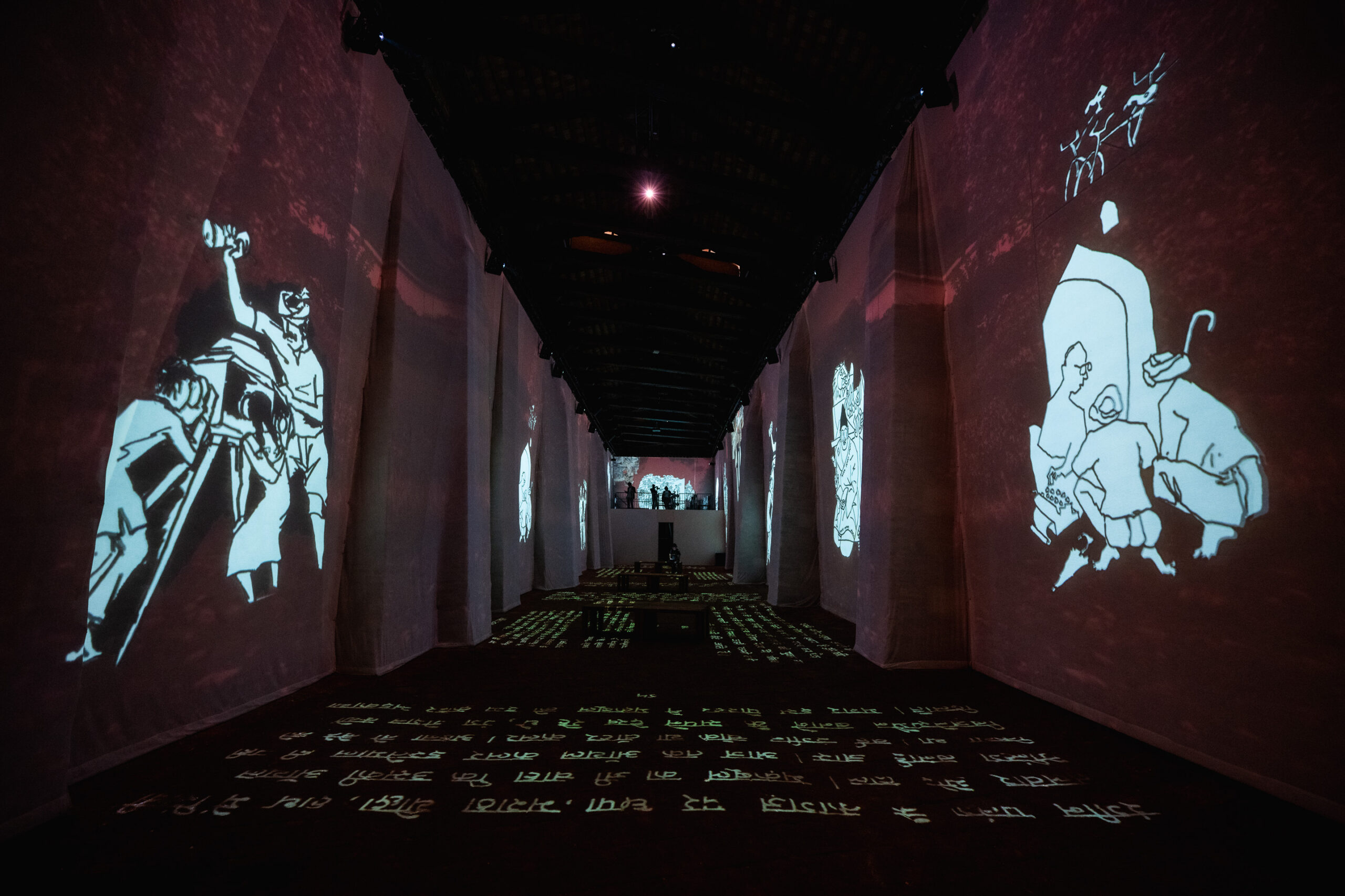
Immersive installation of The Rooted Nomad: M. F. Husain, organised by Kiran Nadar Museum of Art. Designed by Visioni Srl, Rome. Image: Courtesy Kiran Nadar Museum of Art.
This September, Nilima Sheikh: Fractured Skies opens at MoMA in New York and takes the relationship a step further. The exhibition is jointly organised by MoMA and KNMA and co-curated by teams from both institutions. It will also present, for the first time, a group of new works commissioned by KNMA specifically for MoMA’s spaces.
Perhaps this is the real difference between “speaking to the world” and “gaining international exposure”. The latter gives you exposure, but how much exposure is enough and is built to last when the world is saturated with information and people’s attention span is short. “Speaking to the world” , at least to me, gives an institution the opportunity not only to tell the world who it is, but to bring its own knowledge, perspective and way of seeing into the conversation, and in doing so, perhaps help shape that conversation too.
“From India, speaking to the world” also made me think about China — and about that turning wheel with which I began.
Much of what is happening in India today has a precedent in China over the past two decades: private wealth flowing into art, collectors building museums, cultural infrastructure expanding at speed, and local institutions establishing increasingly ambitious relationships with the international art world.
This is not to suggest that models can be transferred neatly between two countries with profoundly different political, economic and cultural conditions. But their experiences do raise some of the same questions. How does private wealth become a cultural institution built to last? And how does an institution remain rooted in its own society while also participating in an international art world?
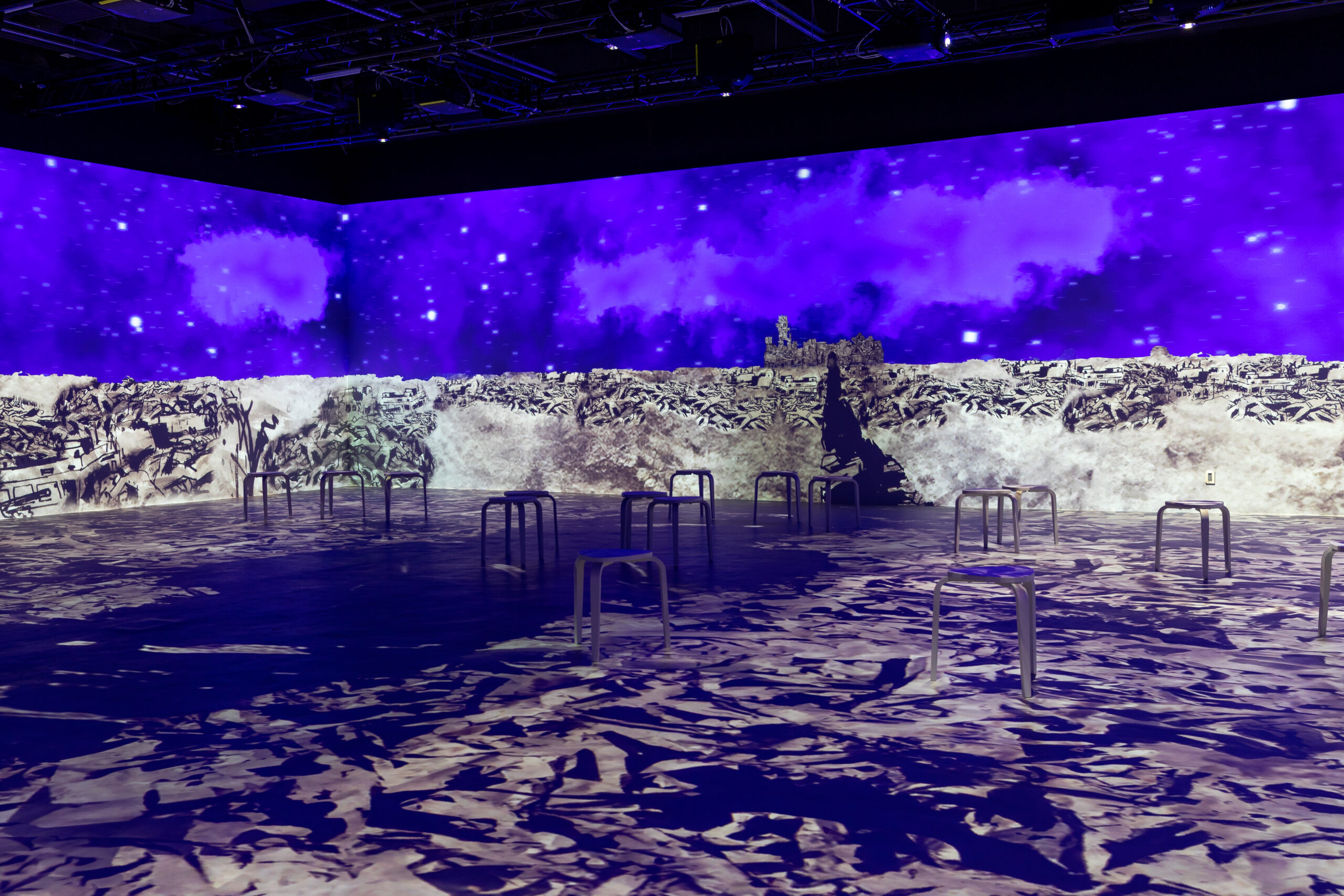
M. F. Husain: The Rooted Nomad, installation view, QM Gallery, Katara Building 10, 28 October 2025–7 February 2026. Photo: © Shaikha Ahmed Ali, courtesy Qatar Museums, 2025.
There is, however, an important difference between the two moments.
When China entered its great museum-building boom, the international art world still revolved around a relatively small constellation of cities in Europe and the US. To be “connected to the world” generally meant gaining entry to that system and building relationships within it.
Over the past two decades, Chinese museums have become increasingly adept at doing precisely that, developing exhibitions and long-term partnerships with major European and American institutions.
The geography in which India’s institutions are now emerging is considerably more plural.
Across the Gulf, India, Southeast Asia and Central Asia, countries are building museums, launching biennials and art fairs, developing collections and creating their own institutional networks. The global art world is consequently moving, however unevenly, from a system dominated by a small number of cultural capitals towards one in which several centres of gravity coexist. KNMA’s collaborations with Sharjah and Qatar form part of this development, as do the growing exchanges between Chinese institutions and those in the Gulf and other emerging cultural regions.
Seen in this context, Nadar’s phrase — “From India, speaking to the world” — starts to describe something larger than the international ambitions of a single private museum.
It is not simply a matter of getting the world to pay attention to India. Indian cultural institutions are increasingly using their own collections, research and curatorial work to help Indian art be better understood by the world and to claim a more active role for it in the making of future global art history.
For China, the question now is somewhat different. After two decades of building international relationships, the next stage may be less about how many international partnerships an institution can accumulate or how much cultural IP it can import, and more about what those relationships actually produce over time, and what China might contribute to a global art history that is itself still being rewritten.